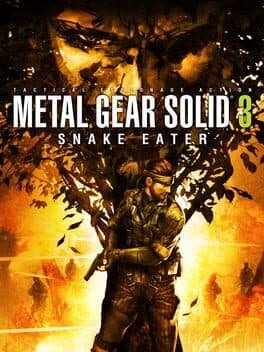
The thing nobody warns you about revisiting a game from 2004 is that the game is fine. It's you that moved.
I came back to Snake Eater expecting to be embarrassed for it. Twenty-odd years is long enough for most things from that era to curdle into something you defend rather than enjoy. And the first hour does nothing to help: you are in a menu changing your shirt, then in a different menu eating a frog, then being told your stamina is low by a woman who mostly wants to talk about movies.
It is a deeply silly game. I had forgotten how silly. There's a man who makes a cat noise. There's an entire James Bond opening. There's a boss who is elderly enough that if you put the game down for a week and come back, he can simply have died.
And then it turns, and it turns so hard that the silliness ends up being the reason it works.
Here is what I thought Snake Eater was about the first time through: sneaking. Camouflage percentages, the sniper duel in the woods, the very long ladder, the song that arrives at the top of it. I would have told you it was the best stealth game on the console and left it there. Which is not wrong, exactly. It is just answering a much smaller question than the one the game is asking.
What it is actually about is The Boss.
She is your mentor. She teaches you everything, in that specific way that someone who is better than you and not interested in flattering you teaches you things. She defects. You are sent after her. The entire operation is built on the idea that she betrayed her country, and the game lets you carry that for hours.
She didn't. She was ordered to. The defection was the mission. She was told to go over, be seen going over, and then die at the hands of her own student so that two governments could avoid a war neither could afford. She agreed to it knowing the record would never be corrected. Not corrected later, not corrected quietly, not corrected for the one person whose opinion of her actually mattered to her. She would be a traitor in every account of it, permanently, and that was the assignment.
And the game does not show you this happening. It makes you do it. You stand in the white flowers and the controller does nothing until you pull the trigger yourself.
Why it lands differently now
At the time I registered that as sad. A sad ending, a good twist, a fight I had to look up how to win.
What I could not have understood then is the specific shape of it, which is not heroism. Heroism was everywhere in games in 2004, and teenagers are well supplied with it. This is something narrower and much worse: doing the correct thing and accepting that you will be remembered wrong for it, by people whose opinion is the only thing you would have wanted to keep.
That is not a fear you have at fifteen. You have to have had some years, and some obligations, and some situations where the right call and the call that makes you look good were not the same call. Then you go back to a PS2 game about a man punching a beehive and it takes the wind out of you.
The salute at the grave, at the end, with nobody watching. That's the whole thing. There's no audience for it. It isn't for anyone. He's paying a debt to a person who arranged her own erasure and he's the only one left who knows what he's paying it for.
That's what The Backlog actually is, for me. Not a stack of games I never finished. Conversations I started as a kid without the vocabulary for them, still sitting there, waiting for me to come back with better questions.
Snake Eater has that room. It was there the whole time, behind the frog eating and the cat noise. I just didn't have the key yet.